
REVIEW · SRI LANKA
PADI Rescue Diver
Good rescue skills matter. This four-day PADI Rescue Diver course in Unawatuna gives you structured practice with real emergency problems, not just more time underwater. I like the serious focus on helping your buddy, and I like that the schedule can mix classroom work with pool or sea exercises according to your fitness and ability. The main drawback is the extra cost: the advertised $378.02 price does not include the 70 Euro PADI manual and certification fee.
I also like the small maximum group of eight, plus the helpful option to complete Emergency First Response training at the same center if your first-aid certificate is too old or missing. Read the meeting point carefully, though. The course information names Negombo as the location, but the actual start and finish point is Divinguru Unawatuna on Matara Road.
Key points to know before booking
- Five theory sections: You complete Knowledge Reviews and a final exam, so this is a proper certification course, not a casual safety talk.
- Ten practical exercises: The course builds rescue skills step by step before moving into two larger rescue scenarios.
- Advanced certification required: You must already be a PADI Advanced Open Water Diver, or hold the equivalent qualification accepted by the center.
- Emergency First Response is essential: You need proof of Primary and Secondary Care training completed within the past 24 months.
- Small class size: The maximum is eight people, which gives you a better chance to receive direct help during demanding exercises.
- The full cost is higher than the headline price: Add 70 Euro for the PADI manual and certification. If you need EFR training, add another 95 Euro plus 70 Euro for its manual, certification, and card.
What the Rescue Diver course is really teaching
The PADI Rescue Diver course is about preventing trouble before it turns into an emergency. You learn to notice stress, poor decisions, equipment problems, and unsafe behavior in the water. That makes the course useful even on ordinary recreational outings, because good rescue work often begins with spotting a problem early.
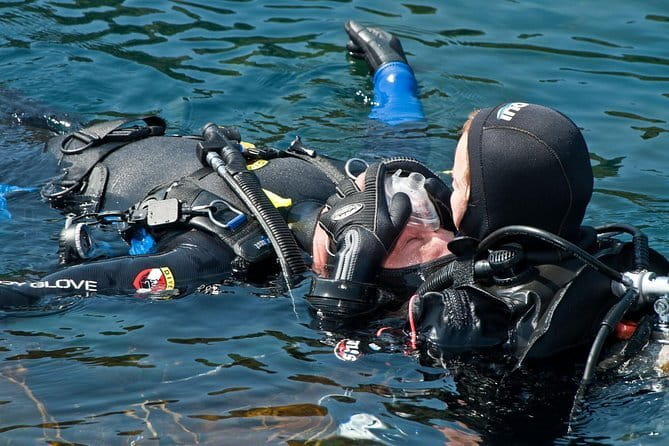
You also learn how to respond when something has already gone wrong. The course covers minor and major emergencies through classroom study, practical exercises, and rescue scenarios. You are expected to solve problems under pressure, communicate clearly, and help another person without putting yourself at unnecessary risk.
I see this as a major step beyond simply collecting another recreational qualification. The course trains you to become a better buddy. You are not only responsible for your own mask, air supply, buoyancy, and comfort. You also learn to pay attention to the person beside you.
That change in mindset is the real value. The certification card is useful, but the stronger benefit is confidence. You practice the same basic responses until they become more natural. The work is serious, but the course also allows time for laughter between the focused sessions. That balance matters, since nervous students usually learn better when the atmosphere is supportive.
More Dive Courses in Sri Lanka:
- PADI Scuba Diver Course
★ 5.0 · 30 reviews - PADI Scuba Diver Course
★ 5.0 · 11 reviews - PADI Advanced Open Water Diver Course
★ 5.0 · 7 reviews
The four-day format and flexible schedule
The course takes about three to five days, with four days listed as the approximate duration. The schedule is flexible, so the exact order can change according to ability, fitness, weather, and the needs of the group.
You should expect a mix of five theory sections, Knowledge Reviews, a final exam, ten practical exercises, and two rescue scenarios. This is enough material that you should not plan it as a rushed add-on at the end of a short beach holiday.
The theory sessions give you the reasoning behind the practical work. You study what to watch for, how to respond, and how to manage different types of emergency. The written work may feel less exciting than the practical sessions, but it gives you the decision-making framework needed when a situation becomes confusing.
The practical section then turns that information into action. You work through ten exercises before taking part in two broader scenarios. This progression is sensible. You first build individual skills, then combine them while dealing with a more complete problem.
Your own fitness level matters. The course requires a moderate level of physical fitness, and that is not a box to tick casually. Helping a tired or distressed person in the water can demand effort, coordination, and calm thinking. If you are uncertain about your fitness, ask the center for guidance before booking.
What happens during the theory sessions
The five theory sections cover the mental side of rescue work. You complete Knowledge Reviews along the way and finish with a final exam. The aim is not to memorize a few emergency phrases. You need to understand what can go wrong and why a particular response is suitable.
The classroom portion also helps you prepare for the exercises. Rescue practice makes more sense when you know what you are trying to observe and correct. You can expect the instructors to connect the written material with the practical situations you will face later.
PADI course materials are not included in the advertised rate. The manual and certification costs add 70 Euro. If you choose PADI Rescue Diver eLearning instead of studying the theory at the center, you must buy it directly from the PADI website and register with Divinguru Unawatuna, PADI 5 Star Dive Resort, S-36133.
That eLearning option may suit you if you want to complete the academic work before arriving. It does not remove the need to register with the center, complete the practical work, and meet all course requirements.
Ten exercises before the two rescue scenarios
The practical training is the heart of the course. Ten exercises give you repeated chances to work on rescue techniques and problem solving. Repetition is useful here. You want basic actions to feel familiar before you face a longer scenario with several things happening at once.
The exercises prepare you to assess a situation, assist another person, and manage your own safety. You will need to pay attention to instructions and accept correction. This is not the place to rush through a task simply to finish first.
After the exercises, two rescue scenarios let you combine the skills. These are likely to feel more demanding because you must decide what to do, rather than simply follow one isolated instruction. The course description does not specify the exact scenarios, so you should ask the center for the current exercise plan if that detail matters to you.
The most useful habit is to stay calm and keep thinking. A rescue is not helped by panic, poor communication, or charging toward a problem without a plan. The course gives you a controlled setting in which to make mistakes, correct them, and try again.
A few more dives around Sri Lanka worth comparing
- Fun Dives For Certified Divers
★ 5.0 · 44 reviews - Discover SCUBA Diving in Beautiful Unawatuna Bay
★ 5.0 · 30 reviews - Fun Dives For Certified Divers
★ 5.0 · 30 reviews - Fun Dives For Certified Divers
★ 5.0 · 22 reviews
Instructors and the learning atmosphere
The teaching team includes Kartik, Ellie, Norbert, and Fraser. Kartik is specifically associated with helping a student understand the importance of the Rescue Diver role. That emphasis is worth noting, because this course works best when the instructor explains not only how to perform a skill, but why it matters.
The center has also been praised for helping students overcome insecurity in the water. That is important if you are capable but not fully confident in an emergency. Rescue training can expose weak spots in your technique, and a patient instructor can turn those moments into useful progress rather than embarrassment.
You should still arrive ready to work. Friendly teaching does not mean an easy course. You will have theory, an exam, physical practice, and scenario work. The relaxed mood simply makes the process less intimidating.
With a maximum of eight people, the group is small enough for individual feedback. It is not a private course, and the exact class size may vary, but the limit is far better than a large group where you spend much of the day waiting.
Prerequisites you must meet
You must be at least 12 years old and already hold Advanced Open Water Diver certification. The course also requires proof of Emergency First Response Primary and Secondary Care training completed within the last 24 months.
The EFR requirement is important. Rescue training is closely linked to first aid, so you should not assume an older certificate will be accepted. Check the date before booking and bring proof with you.
If you do not have current EFR certification, Divinguru can provide the EFR course alongside the Rescue Diver course. The EFR training takes half a day to one day and costs 95 Euro, plus 70 Euro for the EFR manual, certification, and card.
That adds a noticeable amount to the budget. Still, combining the two courses may be convenient, especially if you are already planning to spend several days at the center. It also prevents an expired first-aid qualification from stopping your Rescue Diver training.
The course is not suitable for a complete beginner or someone with only basic open-water training. The Advanced Open Water requirement and moderate fitness requirement are there for good reason.
What is included, and what you still pay for
The $378.02 course price includes scuba equipment, bottled water, coffee or tea, and snacks. Having equipment supplied keeps you from needing to transport or rent every item separately, although you should confirm what is included if you use specialized personal equipment.
Lunch is not included. Plan for that each day, especially because the course may occupy much of the day. The meeting point is Divinguru Unawatuna, PADI 5 Star IDC Dive Resort, 294 Matara Road, Unawatuna 80600, Sri Lanka, and the activity ends back there.
Pickup is offered, but the supplied details do not explain the pickup area or whether an additional fee applies. Confirm this directly before relying on it. The center is near public transportation, which gives you another way to reach the start point.
The largest budget trap is the separate PADI charge. The 70 Euro fee covers the PADI Rescue Diver manual, certification, and card. The course price should therefore be treated as a starting figure, not the final total.
If you need EFR as well, the extra costs are 95 Euro for the course and 70 Euro for the EFR manual, certification, and card. Ask for the complete price in writing before you commit.
Is the $378.02 price good value?
For a multi-day certification course with equipment use, instruction, practical exercises, theory, and scenario training, the base price can be reasonable. The value is strongest if you want a genuine safety qualification rather than a single guided underwater outing.
The price becomes less attractive if you already own equipment, need only a short refresher, or have limited time in Sri Lanka. You are paying for several days of structured training, not just time in the water.
Remember to add the 70 Euro PADI fee. If you also need EFR, the total increases sharply. The course remains worthwhile for someone planning to continue into serious recreational training or eventually work toward Divemaster, but you should calculate the complete cost before comparing it with centers elsewhere.
The small class limit and the flexible three-to-five-day format add value. You are less likely to be pushed through a fixed timetable if you need more practice. On the other hand, flexible scheduling means you should keep spare time available rather than booking your airport transfer immediately after the stated fourth day.
Getting to the right location in Sri Lanka
The information identifies the experience with Negombo, but the meeting point is in Unawatuna near Galle. These are not interchangeable places. Use the exact Unawatuna address when planning transport, accommodation, and onward travel.
The start and finish point is Divinguru Unawatuna on Matara Road. Since the course runs over several days, staying nearby may be more practical than commuting long distances each morning.
Pickup is listed as available, but details are limited. Confirm the pickup zone, timing, and price before booking. The center is also near public transportation, so you are not dependent on a private transfer if you are staying close by.
The activity returns to the meeting point at the end. That makes it easier to plan your day, but it does not mean lunch or transport back to your hotel is included.
Weather, cancellation, and timing advice
The course requires good weather. If poor weather causes cancellation, you will be offered another date or a full refund. The same applies if the minimum number of participants is not met.
You can cancel for a full refund up to 24 hours before the start time. Cancellations and changes made less than 24 hours before the experience are not accepted, and the local time in Sri Lanka controls the cutoff.
I would avoid scheduling this course directly before an international flight. The listed duration is approximate, and the flexible plan may extend to five days. Give yourself room for weather changes, extra practice, or a delayed final session.
Confirmation is normally received at booking. If you book within one day of departure, confirmation arrives as soon as possible and remains subject to availability.
Who should book this course?
This course suits an Advanced Open Water Diver who wants to become a more responsible buddy and feel calmer during emergencies. It is also a good fit if you are considering the PADI professional route, since one student progressed through the course toward Divemaster training with Kartik’s support.
It should appeal to you if you like learning through practice and do not mind written study. The combination of five theory sections, ten exercises, two scenarios, and a final exam requires attention.
It may not suit you if you want a relaxed holiday activity, have no recent first-aid training, or cannot spare three to five days. It is also a poor match if your fitness is limited or you are not comfortable with the Advanced Open Water prerequisite.
Should you book the PADI Rescue Diver course?
Book it if you already meet the certification and first-aid requirements, have several days in Unawatuna, and want skills that can protect both you and your buddy. The course earns its price through repeated practice, a small maximum group, supplied equipment, and a clear path from theory to realistic rescue scenarios.
Before paying, confirm the Unawatuna location, pickup details, total cost with the 70 Euro PADI fee, and whether you need EFR training. If those details fit your plans, Divinguru offers a supportive setting for serious training with enough humor to keep the hard work manageable.
FAQ
Where does the PADI Rescue Diver course start?
It starts and finishes at Divinguru Unawatuna, PADI 5 Star IDC Dive Resort, 294 Matara Road, Unawatuna 80600, Sri Lanka.
How long does the course take?
The course takes around three to five days, with four days listed as the approximate duration. The schedule is flexible.
Is Advanced Open Water certification required?
Yes. You must be an Advanced Open Water Diver and meet the other stated prerequisites.
Do I need Emergency First Response certification?
Yes. You need proof of Primary and Secondary Care training completed within the previous 24 months.
Can I complete EFR at the same center?
Yes. Divinguru offers EFR training alongside the Rescue Diver course. It takes half a day to one day and costs 95 Euro, plus 70 Euro for the manual, certification, and card.
Is the PADI manual and certification fee included?
No. The PADI manual and certification costs add 70 Euro. PADI Rescue Diver eLearning must be purchased through the PADI website if you choose that study method.
What is included in the course price?
The course includes bottled water, coffee or tea, snacks, and use of scuba equipment. Lunch is not included.
New dives around Sri Lanka
- Scuba Diving For Beginners★ 5.0 · 18 reviews
- 3 Hour Guided Scuba Diving in Trincomalee★ 5.0 · 2 reviews
- PADI Scuba Diver Course★ 5.0 · 11 reviews
- PADI Advanced Open Water Diver Course★ 5.0 · 7 reviews
- Scuba Diving For Beginners★ 5.0 · 10 reviews
- Scuba Diving in Kalpitiya★ 5.0 · 2 reviews
- Scuba Diving in Mirissa★ 5.0 · 12 reviews
- Fun Dives For Certified Divers★ 5.0 · 22 reviews
PADI Courses & Certification, compared.
Tossa de Mar: PADI Discovery Scuba Diving in Costa Brava
Read our review →
Full-Day Beginner Scuba Course with Private Tuition, Racha Yai
Read our review →
Beginner Scuba Diving Lesson with PADI Instructor
Read our review →
Discover Scuba Diving with No Certification in St Thomas
Read our review →
Try Dive – PADI Discover Scuba Diving in Tenerife
Read our review →
Browse the lists this tour appears in