
REVIEW · TENERIFE
PADI Open Water Diver Course
Tenerife puts the underwater world within reach. This three-day PADI course combines classroom study, practical training, and open-water sessions around Costa Adeje. I like the small groups and the friendly, patient instruction from staff such as Juan, Gerhard, Manuel, Nelly, and Pauli. I also like that the course includes equipment, study materials, logbook, license fees, and transport within the pickup zone.
The main consideration is the price: $792.16 per person is a serious part of a Tenerife holiday budget. You also need reasonable health and moderate fitness, and the course can take much of each day. Lunch is not included, and pickup limits need checking because the information gives both a 10-mile and 10-kilometer limit.
Key points to know before booking
- Three days from beginner to certified diver: You learn the basic theory and practical skills needed for independent scuba use around the world.
- Small-group instruction: The course is designed around personal attention, with past sessions sometimes limited to about four students.
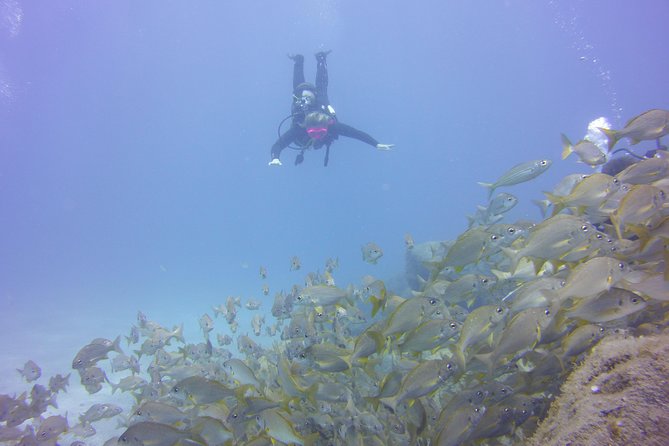
- Volcanic underwater scenery: Tenerife’s seabed offers rock formations and marine life, including octopus, cuttlefish, turtles, rays, barracuda, and moray eels.
- Four required training sessions, with schedules varying: Some participants completed four formal sessions, while another recorded five sessions across three days.
- Transport and equipment included: Pickup and return are available in the stated service area, and full scuba equipment is supplied.
- Good preparation matters: Plan for about 8 to 12 hours of theory, bring dry clothing, and take pressure equalization slowly from the first meter downward.
What the three-day course is really like
This is not a quick tourist dip followed by a certificate. The PADI Open Water program teaches you how to manage yourself underwater, use your equipment, respond to common problems, and plan safe recreational sessions.
The course is offered in English, and instruction takes place in small groups. The small-group setup matters. You are learning skills that must become automatic, such as clearing a mask, controlling buoyancy, and dealing with an air supply. An instructor who can watch you closely is more useful than a large group moving through exercises at the same speed.
The official format takes about three days. The practical work generally involves four open-water sessions, though the exact number can vary with the schedule and student progress. One participant described five sessions over three days, including an introductory session and further practice. Treat that as a useful indication of how the timetable may be arranged, not as a promise of a fixed number.
You should expect to spend much of the day at the center or at the water. A morning session may not return you to your hotel before 2 p.m. If you are planning another major excursion on the same day, leave plenty of room in your schedule.
More PADI Courses in Spain
- Try Dive – PADI Discover Scuba Diving in Tenerife
★ 5.0 · 214 reviews - PADI Open Water Diver Course (OWD) – 2.5 days
★ 5.0 · 98 reviews - PADI Discover Scuba Diving Course in Tenerife
★ 4.8 · 64 reviews
Starting at Ocean Trek in Costa Adeje
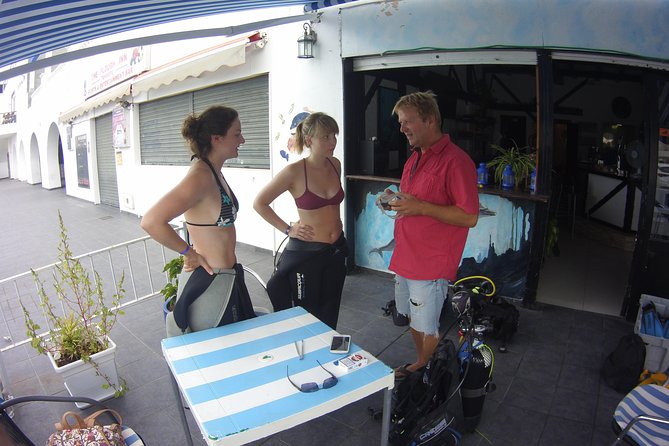
The meeting point is Ocean Trek at C. Valencia in Costa Adeje. This puts the course in one of Tenerife’s main holiday areas, with public transport nearby. The activity returns to the meeting point at the end.
Hotel pickup and return are available by request. The supplied details give a maximum distance of 20 kilometers in one section and 10 kilometers in another, so you should confirm the exact limit for your hotel before booking. That small check can save you an awkward taxi ride at the start of a long training day.
The private format is another useful feature. Only your group takes part, rather than joining a large general excursion. In practice, the small groups have sometimes been about four students, though group size can change. A small operation also means the pace may be adjusted if you need another explanation or another attempt at a skill.
Bring dry clothes for the ride back. You will also appreciate an extra towel, especially if the second session involves changing in a parking area rather than at a full indoor facility. A changing poncho is a practical addition. Wet swimwear, a hot surface, and a vehicle do not make a happy combination.
Theory before you enter the water
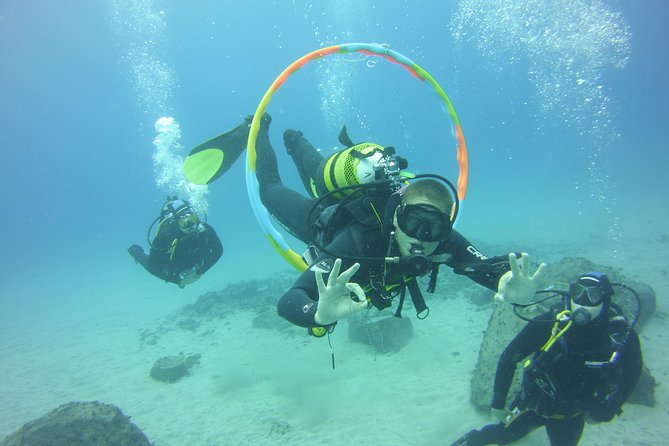
The theory section explains how scuba equipment works, how pressure affects your body, how to plan a safe session, and what to do when something does not go as planned. You do not need to arrive as an expert, but you do need to take the study seriously.
One course participant completed the PADI eLearning portion before arriving and estimated 8 to 12 hours of study. Spreading that over 1 or 2 hours per day is more manageable than trying to cram everything into one evening in Tenerife.
The online part includes a test, followed by additional questions at the center to confirm that you completed the work yourself. That is a sensible safety check. The course is not asking you to memorize a textbook word for word, but you should understand the ideas well enough to apply them underwater.
If your English is not comfortable for technical instruction, ask about available language options before booking. The advertised course is offered in English. Some past participants completed instruction in German, but that does not mean every date or instructor supports German.
The first water session: getting comfortable
The first practical session is designed to move the theory into real equipment and real water. You learn how the mask, regulator, buoyancy device, tank, and other gear feel when you are wearing them.
This is where a calm instructor makes a major difference. Juan received particular praise for taking a complete novice through the course in a steady way. Manuel was also described as careful and effective during the skills practice. Gerhard, the center’s owner, has been involved in teaching and organizing small sessions, while Nelly, Pauli, Gema, Ryan, Maria, and Sean have also been named as part of the team in past courses.
The training style is simple and sensible: explain, demonstrate, imitate, and practice. You are not expected to perform a skill perfectly on the first attempt. If a mask fills with water or you struggle with buoyancy, the instructor can slow things down and repeat the exercise.
One useful point from previous instruction is to avoid overworking your calf muscles. Leg cramps are an unpleasant distraction underwater. Use your fins with controlled movements rather than kicking hard, and tell the instructor if your legs begin to tire.
More PADI Courses in Tenerife
- Basic Diver course for beginners with 1 dive in the Ocean
★ 5.0 · 41 reviews - PADI Scuba Diving Courses in Tenerife: All Specialities Until Divemaster
★ 5.0 · 39 reviews - PADI Open Water course in Playa de las Americas
★ 5.0 · 36 reviews - DISCOVER SCUBA DIVING – First step to your certification
★ 5.0 · 29 reviews
Skills practice in shallow water
The next sessions focus on the core skills required for certification. These include the basic tasks that help you stay calm and solve small problems underwater.
The training often takes place in relatively shallow water, around 5 to 10 meters in one reported course. That may not sound dramatic, but shallow water is a good setting for learning. You can concentrate on technique instead of feeling overwhelmed by depth.
Pressure equalization deserves special attention. Start early, as soon as you notice pressure in your ears. If you already feel strong discomfort, rise slightly, then try again gently. Do not force the maneuver. Taking a meter back up and equalizing without strain is much kinder to your ears than pushing hard.
This is also the stage where buoyancy begins to make sense. Good buoyancy helps you use less air, move with less effort, avoid touching the seabed, and feel more in control. It can take time. One instructor specifically praised a student’s buoyancy, while another participant appreciated having enough time to practice rather than being rushed along.
Open-water sessions around Tenerife
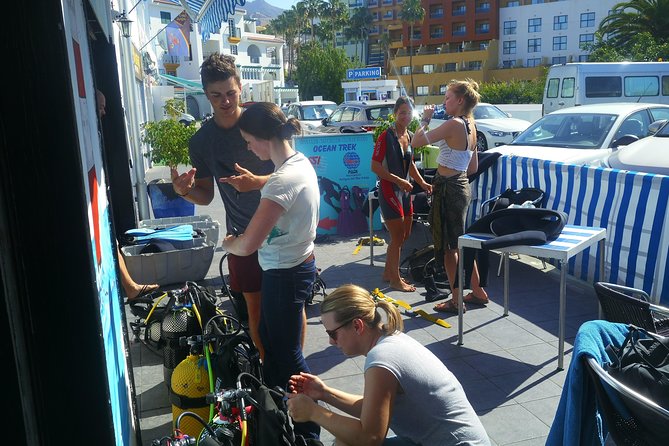
Once the basic skills are in place, you visit open-water sites around Tenerife. The course description promises two sessions per day and a range of sites, while individual schedules have included three locations across the course.
The appeal is not only the animals. Tenerife is volcanic, and the underwater rock formations give the seabed a different character from a flat sandy site. You may see fish moving around the rocks, along with the occasional larger creature that makes the session memorable.
Past course participants recorded sightings of cuttlefish, octopus, sea turtles, stingrays, barracuda, and moray eels. Turtles and rays are never something a course can guarantee, but the possibility adds excitement to the training. The main goal remains certification and safe technique, not a wildlife checklist.
The final session may include more people than the earlier training sessions, although beginners can still remain with their own instructor. One past schedule had about ten people at the final location, with two beginners assigned to one instructor. Ask about the expected group size if personal attention is your top priority.
Equipment, water, and what is included
The package includes full scuba equipment, course literature, a logbook, PADI license fees, bottled water, and pickup and return within the stated service area. Those inclusions make the price easier to assess because you are not building the cost from separate equipment rental and certification charges.
You still need to budget for lunch. The long sessions and travel time make it sensible to carry food or plan a meal around the timetable, although you should follow the center’s instructions about eating before practical training.
A logbook is a nice practical touch. It gives you a record of your training and future sessions. The certification itself allows you to rent scuba equipment, have tanks filled, and take part in independent recreational scuba sessions around the world, subject to local rules and operator requirements.
The phrase independent does not mean careless. After certification, you still need a suitable buddy, appropriate conditions, and honest judgment about your experience. Your first qualification is a starting point, not permission to ignore local guidance.
Is $792.16 good value?
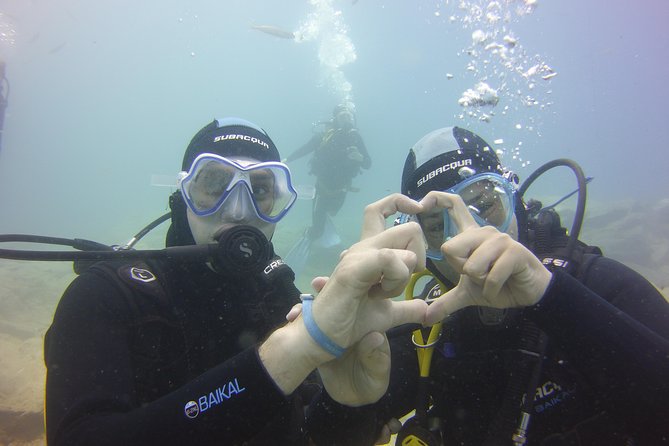
At $792.16, this is not a budget activity. It makes more sense when you count what is included: instruction across about three days, full equipment, learning materials, the logbook, PADI fees, bottled water, and transport within the service area.
Small-group teaching also has real value. A cheaper course with a large group may give you less time for questions and practice. Here, several past sessions used only a few students per instructor, and the instruction was repeatedly described as friendly, professional, and unhurried.
The price is easiest to justify if you want a qualification you can use beyond Tenerife. If you only want one short underwater experience during a beach holiday, a beginner tryout session may cost less and take less time. If you already know you want to continue with scuba, completing the full PADI qualification can be a practical use of three days.
Older course pricing mentioned by one participant was much lower, but that figure is not a reliable guide to the current cost. Use the current advertised price when planning your budget, and confirm exactly what is included at the time of booking.
Who should choose this course?
This course suits a first-time student who wants proper instruction rather than a quick photo opportunity. It also suits couples or friends who prefer a private booking and want to learn together.
You must be at least 10 years old, in reasonable health, and moderately fit. The center allows service animals and is near public transport, but the practical work still requires you to handle equipment and remain comfortable in the water.
I would choose this course if you value patience, small groups, and a careful introduction to scuba. I would hesitate if your Tenerife schedule is packed, you dislike structured study, or you only want a single short session.
The strongest pattern in the teaching is personal attention. Juan, Gerhard, Manuel, Nelly, and Pauli have all been praised for calm explanations, friendly support, and adapting to different skill levels. That is exactly what you want when the water feels unfamiliar.
Booking, weather, and cancellation details
You receive confirmation when you book. Free cancellation is available up to 24 hours before the local start time. Cancellations or changes made inside that window are not refunded or accepted.
The course depends on suitable weather. If conditions force cancellation, you can choose another date or receive a full refund. Since the program takes three days, check your wider Tenerife plans before selecting a start date.
Confirm three practical points in advance: the pickup radius for your hotel, the language of instruction, and the expected daily schedule. The published material contains two different pickup distances, and clarifying that detail is worthwhile.
Final verdict: should you book it?
Book this course if you want a real PADI qualification, small-group teaching, and the chance to see Tenerife’s volcanic seabed while you learn. The price is high, but the package is substantial and the instruction appears built around patience rather than rushing students through.
Choose another activity if you want a quick holiday outing, dislike study, or cannot spare three days. For a committed beginner, though, Ocean Trek offers a strong mix of safety practice, personal guidance, and worthwhile underwater scenery. Pack dry clothes, protect your ears by equalizing early, and leave your afternoons flexible.
FAQ
How long is the PADI Open Water course?
The course lasts approximately three days. The practical program includes several water sessions, with the standard training described as four sessions, although schedules can vary.
What is included in the price?
The price includes pickup and return within the service area, full scuba equipment, course literature, a logbook, PADI license fees, and bottled water. Lunch is not included.
Is hotel pickup available?
Yes. Pickup and return are available by request. The supplied information gives both 10 kilometers and 20 kilometers as possible limits, so confirm the exact distance for your hotel before booking.
What is the minimum age?
The minimum age is 10 years.
Is the course offered in English?
Yes. English is one of the listed languages for the experience.
What happens if bad weather cancels the course?
You can choose a different date or receive a full refund if the experience is canceled because of poor weather.
More Dive Courses in Tenerife
- Santa Cruz de Tenerife: PADI Introductory Dive
★ 4.8 · 23 reviews - PADI Advanced Open Water Diver Course (AOWD) – 2 days
★ 5.0 · 18 reviews - PADI Open Water Course in Costa Adeje
★ 4.5 · 17 reviews - PADI Open Water Course in 3 Days
★ 5.0 · 9 reviews
New dives around Tenerife
- Tenerife: 2 Diving Sessions for Certified Divers★ 4.2 · 7 reviews
- Beginner Scuba Dive with Scubapoint Tenerife in Turtle Area★ 4.7 · 8 reviews
- Scuba Experience in Tenerife with Guide★ 5.0 · 30 reviews
- Try Scuba Diving Puerto Colon★ 5.0 · 2 reviews
- Scuba Diving in Turtle and Ray Area★ 5.0 · 7 reviews
- Scuba Night Dive on Tenerife★ 5.0 · 6 reviews
- First Dive Experience in Tenerife★ 4.5 · 69 reviews
- Scuba Adventure – 2 Guided Dives from Our Boat in Tenerife★ 5.0 · 12 reviews
PADI Courses & Certification, compared.
Tossa de Mar: PADI Discovery Scuba Diving in Costa Brava
Read our review →
Full-Day Beginner Scuba Course with Private Tuition, Racha Yai
Read our review →
Beginner Scuba Diving Lesson with PADI Instructor
Read our review →
Discover Scuba Diving with No Certification in St Thomas
Read our review →
Try Dive – PADI Discover Scuba Diving in Tenerife
Read our review →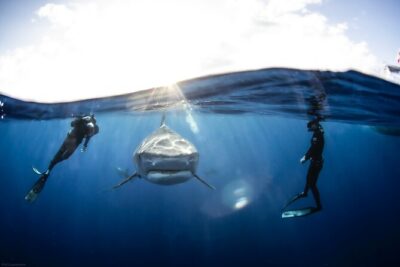
Browse the lists this tour appears in