
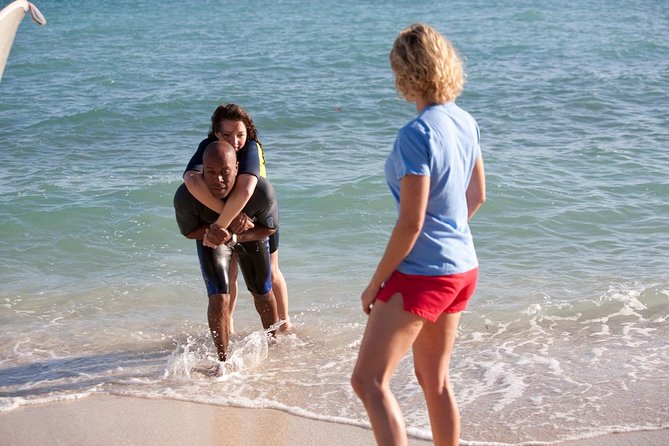
REVIEW · GRAN CANARIA
PADI Rescue Diver Course in Gran Canaria
Rescue skills matter most when a calm day turns serious. This two-day PADI Rescue Diver Course in Gran Canaria combines classroom theory, pool or bay practice, and realistic exercises at Amadores Beach. I like the small maximum of six people and the clear focus on self-rescue, unresponsive divers, and surface emergencies. I also like that PADI materials, certification fees, insurance, and selected hotel transfers are included. The main consideration is simple: this is a demanding course, not a relaxed holiday activity, and you need an existing PADI Open Water certificate.
Blue Water Diving has a strong reputation for friendly, clear instruction. Chris receives especially warm praise for his professional and approachable teaching, while Kate is noted for making arrangements easy and keeping communication straightforward. The $397.58 price is reasonable if you value formal certification and close instruction, though you will need to arrange your own food and drinks.
Key points to know before booking
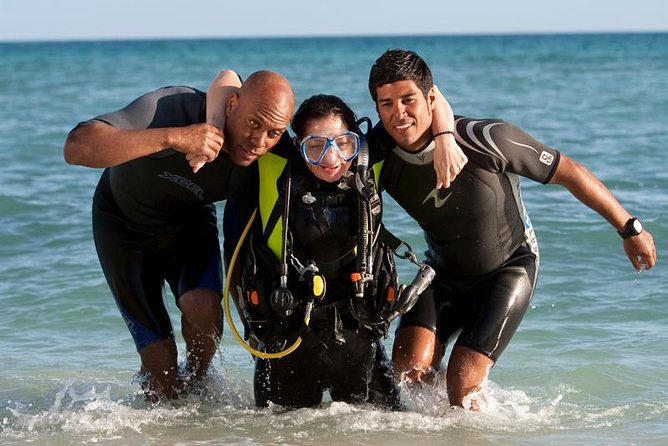
- Two days of serious skill training: You learn rescue methods, emergency response, and self-rescue rather than simply touring underwater.
- Practice starts in a pool or Amadores Bay: The first day lets you learn techniques in a controlled setting before the beach scenarios.
- Two rescue scenarios take place at Amadores Beach: The second day puts your new skills into practical exercises.
- Small groups are capped at six people: That should allow more direct guidance than a large class.
- Transfers may be included: Hotel pickup and return are offered at selected Gran Canaria hotels.
- You need medical and certification clearance: Bring proof of PADI Open Water certification and complete the required health questionnaire.
What this Gran Canaria rescue course is really for
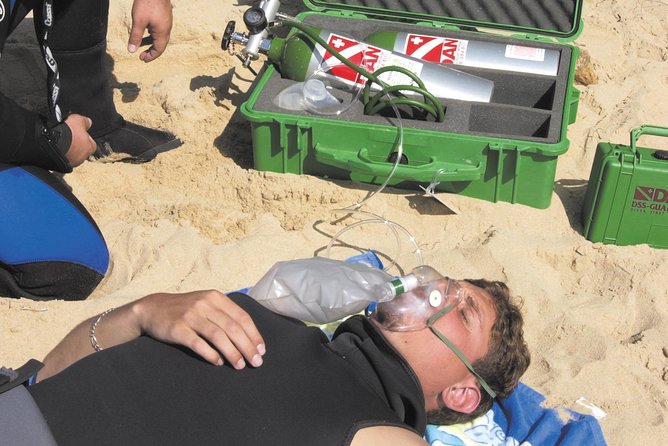
The PADI Rescue Diver qualification is aimed at certified recreational divers who want to become more capable and more useful in an emergency. You are not simply learning how to assist someone after an incident. You are also taught to manage your own stress, recognize trouble early, and respond to an unresponsive or unconscious person underwater and at the surface.
That distinction matters. Many people finish Open Water training feeling comfortable with normal conditions but less certain when something goes wrong. This course addresses that gap through repeated practice and simulated problems.
I like the course design because it moves from instruction to controlled practice, then to more involved scenarios. You first learn the methods in a local bay or the onsite pool. The following day, you use those skills during two rescue situations at Amadores Beach. That order gives you time to understand each action before you must put several actions together.
You should expect physical effort and concentration. The operator asks for a moderate level of fitness, and the course may be tiring even though it lasts only about two days. It is best suited to someone who wants a qualification and is willing to work for it, rather than someone looking for an easy activity between beach visits.
More PADI Courses in Spain
- Gran Canaria:Live an Adventure and Learn to Dive with Expert
★ 4.7 · 109 reviews - PADI Open Water Course in Gran Canaria
★ 5.0 · 79 reviews - 2 Dive Package for PADI Qualified Divers in Gran Canaria
★ 5.0 · 64 reviews
Day one at Amadores Bay or the onsite pool
The first day is the foundation. Depending on conditions and the teaching plan, instruction takes place in the local bay at Amadores or in the onsite pool. Both settings have a clear purpose.
A pool offers control. You can focus on body position, communication, equipment handling, and rescue movements without the distractions of an open-water setting. A bay gives you a closer link to the conditions you will face later, while still providing a contained area for instruction.
You learn self-rescue skills first. This is one of the most useful parts of the course because assisting another person begins with staying safe yourself. If you panic, exhaust yourself, or lose control of your equipment, you add another person to the emergency.
The instruction also covers how to deal with an unresponsive or unconscious diver underwater and on the surface. The wording matters here. You are not learning just one lift or one response. You are learning to recognize the problem and work through an emergency procedure in different positions.
Expect demonstrations followed by your own practice. The small group limit of six should help here. In rescue training, it is important to have enough time to perform the technique, receive correction, and repeat it. A crowded class can leave you watching more than doing.
The course also includes theory. That may sound less exciting than the practical work, but it gives the exercises their meaning. You need to understand what you are seeing, what order to follow, and how to avoid making the situation worse.
Day two at Amadores Beach
The second day moves to Amadores Beach for two rescue scenarios. This is where the course becomes more than a collection of separate skills.
A scenario asks you to think. You may need to identify a problem, approach it carefully, assist the person, and manage the situation at the surface. The point is not to perform a single movement perfectly in isolation. The point is to build a sensible response under pressure.
Amadores is also a practical setting for this stage because the training takes place at a real beach rather than only in a pool. The exact conditions can vary, so you should be ready for a more active day than the first. That said, the exercises are simulated and conducted as training in a controlled environment.
I would treat these scenarios as the most valuable part of the course. You get to test your judgment, not just your memory. You also find out which skills feel natural and which need more work.
Do not expect the two scenarios to feel like a sightseeing stop with a little instruction added. They are the central assessment portion of the program. Come rested, listen closely, and be prepared to repeat a technique if your instructor wants a safer or clearer response.
Teaching style from Blue Water Diving
The strongest praise for Blue Water Diving centers on its staff. Chris is repeatedly described as clear, professional, friendly, and easy to talk with. One participant specifically praised his rescue instruction for being both professional and welcoming.
That combination is important in a rescue class. You need direct correction, but you also need to feel comfortable asking questions when a procedure is unclear. An instructor who explains the reason behind a technique can help you remember it later, when you are no longer standing beside the training site.
Kate also plays a key role in the customer experience. Communication and logistics are described as easy to arrange, which is useful when you need to confirm pickup, certification documents, timing, and medical requirements. The team has also supported people through advanced training and longer professional programs, suggesting that this is not a casual operation built around one-off excursions.
The operator has earned praise for personalized attention, safety, and a friendly atmosphere. I would still keep your expectations realistic. A pleasant staff cannot remove the physical demands of the course, and a warm teaching style does not mean the assessment is effortless.
More Dive Courses in Gran Canaria:
- Open Water Diver Scuba Diving Course in Puerto de Mogan
★ 5.0 · 27 reviews - PADI Advanced Diving Course in Gran Canaria
★ 5.0 · 25 reviews - 2 Day PADI Scuba Diver Course in Puerto Rico, Gran Canaria
★ 5.0 · 7 reviews - Las Palmas: 2-Day Padi Scuba Diving Course
★ 5.0 · 4 reviews
Group size, pickup, and the practical start
The maximum group size is six people. That is a favorable limit for a skills-based course. You should have a reasonable chance to practice directly and receive individual feedback, though the exact amount of one-to-one time will depend on the group and the pace of instruction.
The listed meeting point is the Euronet ATMManixa at C. Doreste y Molina, 18, in Puerto Rico, Las Palmas. The stated start time is 9:00 am, and the activity returns to the meeting point at the end.
Hotel pickup and drop-off are included for selected hotels only. Confirm that your accommodation qualifies before assuming a transfer is available. If it does not, plan to reach the Puerto Rico meeting point yourself. The area is near public transportation, which gives you another way to organize the morning.
The mobile ticket is convenient. You can keep the booking details on your phone rather than print paperwork, but you still need to bring proof of your PADI certification. Evidence of certification is required from every participant taking part in the certified course.
What the $397.58 price includes
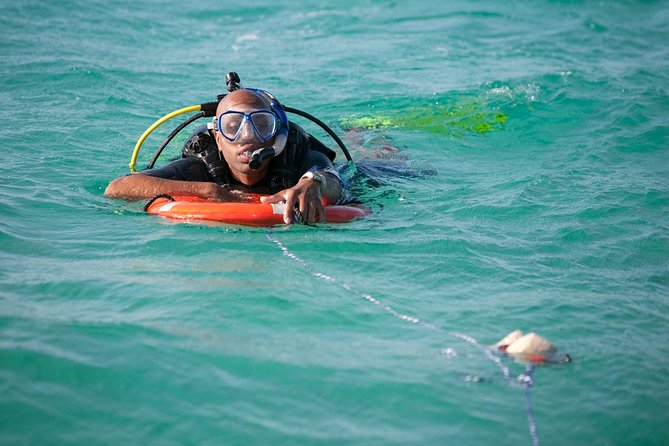
At $397.58 per person, this is not a budget beach outing. It is a professional qualification course, so the right comparison is with the cost and effort of obtaining formal rescue training elsewhere.
The fee includes a professional guide, required PADI materials, certification fees, and insurance. Those inclusions add real value. You are not paying only for instruction and then facing a separate charge for course materials or certification at the end.
Hotel transfers are also included for selected hotels, which can save both time and transport costs. The small group size adds value as well, since close supervision matters more here than it would on a simple recreational excursion.
Food and drinks are not included. Pack or purchase what you need for the day, but keep the timing and physical effort in mind. You may not want to rely on a long restaurant stop between training sessions.
The price makes the most sense if you are already planning to earn the PADI Rescue Diver qualification. If you only want a casual water activity, this course is too specialized and too demanding for the money.
Safety, health, and certification requirements
You must already hold a PADI Open Water certification. Bring evidence of that qualification. Without it, you cannot simply join as a beginner because the rescue course assumes you already understand basic underwater procedures.
Every participant must complete a health questionnaire before entering the water. Conditions such as asthma or heart problems may prevent participation, so consult your doctor if you have a relevant medical concern. The operator does not promise that every participant will be cleared to take part.
You should also avoid scuba activity within 48 hours of flying. That rule matters when planning your holiday. Do not schedule the course right before your return flight if the timing leaves less than the recommended interval.
The insurance included in the price is helpful, but it does not remove the need to answer the health questions honestly or follow the instructor’s safety directions. You should arrive ready to disclose any condition that could affect your ability to exercise or respond in the water.
Who should book this course
This course suits you if you already hold PADI Open Water certification and want greater confidence around emergencies. It is also a good choice if you are planning more advanced recreational training or considering a future Divemaster path. Blue Water Diving has experience supporting advanced students and professional trainees, and that background may appeal to someone who wants a longer training relationship.
It is less suitable if you want a quiet day in the sun. You will need moderate fitness, two available days, attention during theory, and a willingness to repeat difficult skills.
The course can also suit returning customers who already know the center. The team has welcomed people back for advanced qualifications, and Chris and Kate are praised for building a friendly, personal atmosphere. Still, you do not need prior experience with this center to benefit from the course.
Booking, cancellation, and timing tips
Confirmation is provided when you book. Cancel at least 24 hours before the 9:00 am start time for a full refund. Cancellations or changes made within 24 hours are not accepted for a refund, and cut-off times follow local time in Gran Canaria.
I would confirm three things before paying: that your hotel qualifies for pickup, that your PADI certification evidence is available, and that the course timing leaves at least 48 hours before any flight. Those checks prevent the most obvious problems.
Because food and drinks are excluded, plan your own refreshments. Also allow enough time to reach the meeting point if you are not using the included transfer.
Should you book the PADI Rescue Diver Course in Gran Canaria?
Book it if you want serious rescue training in a small group, with PADI materials, certification costs, insurance, and selected hotel transfers included. The progression from pool or bay practice to two Amadores Beach scenarios is sensible, and the teaching team has earned strong praise for clear, friendly instruction.
Skip it if you are not already PADI Open Water certified, have limited physical fitness, or want a light holiday activity. The $397.58 fee is good value for a qualification course, but only if you intend to use the training.
For the right participant, this is a practical way to become calmer, more prepared, and more useful when an underwater emergency occurs. Just schedule it carefully around flights and come ready to work.
FAQ
Do I need a PADI Open Water certification?
Yes. Evidence of dive certification is required from all participants taking the certified course.
How long does the course last?
The course lasts approximately two days.
Where does the first day take place?
The first day takes place either in the local bay at Amadores or in the onsite pool.
Where are the rescue scenarios held?
The two rescue scenarios are completed at Amadores Beach on the second day.
What time does the course start?
The stated start time is 9:00 am. The listed meeting point is the Euronet ATMManixa at C. Doreste y Molina, 18, Puerto Rico, Las Palmas.
Is hotel transportation included?
Hotel pickup and drop-off are included for selected hotels only. The activity begins and ends at the stated meeting point.
What should I know about flying after the course?
Diving within 48 hours of flying is not recommended. Plan your course and return flight with that interval in mind.
New dives around Gran Canaria
- PADI Advanced Diving Course in Gran Canaria★ 5.0 · 25 reviews
- Open Water Diver Scuba Diving Course in Puerto de Mogan★ 5.0 · 27 reviews
- PADI Open Water Course in Gran Canaria★ 5.0 · 79 reviews
- 6 Diving Sites Scuba Diving Package in Gran Canaria★ 5.0 · 6 reviews
- Scuba Diving Experience at Arguineguin and Puerto Rico★ 5.0 · 9 reviews
- Discover Scuba diving in Gran Canaria with Hotel Pick-up★ 5.0 · 69 reviews
- Gran Canaria 3 days / 6 dives in Various Locations★ 5.0 · 19 reviews
- Children’s PADI Diving Experience in Gran Canaria★ 5.0 · 2 reviews
PADI Courses & Certification, compared.
Tossa de Mar: PADI Discovery Scuba Diving in Costa Brava
Read our review →
Full-Day Beginner Scuba Course with Private Tuition, Racha Yai
Read our review →
Beginner Scuba Diving Lesson with PADI Instructor
Read our review →
Discover Scuba Diving with No Certification in St Thomas
Read our review →
Try Dive – PADI Discover Scuba Diving in Tenerife
Read our review →
Browse the lists this tour appears in